
The aim of this article is to:
- provide a comprehensive overview of the criteria for choosing a heating system,
- use these criteria to compare commonly used heating technologies,
- and assess when and why radiant heating can truly be the best choice.

In our climate, heating is one of the most important systems in a home, affecting comfort, running costs and the overall condition of the building. That’s why it’s worth considering not only the type of heat source but also which approach to heating best meets the specific needs of your home. Your choice of heating system will shape your comfort, household budget and everyday life for decades to come.
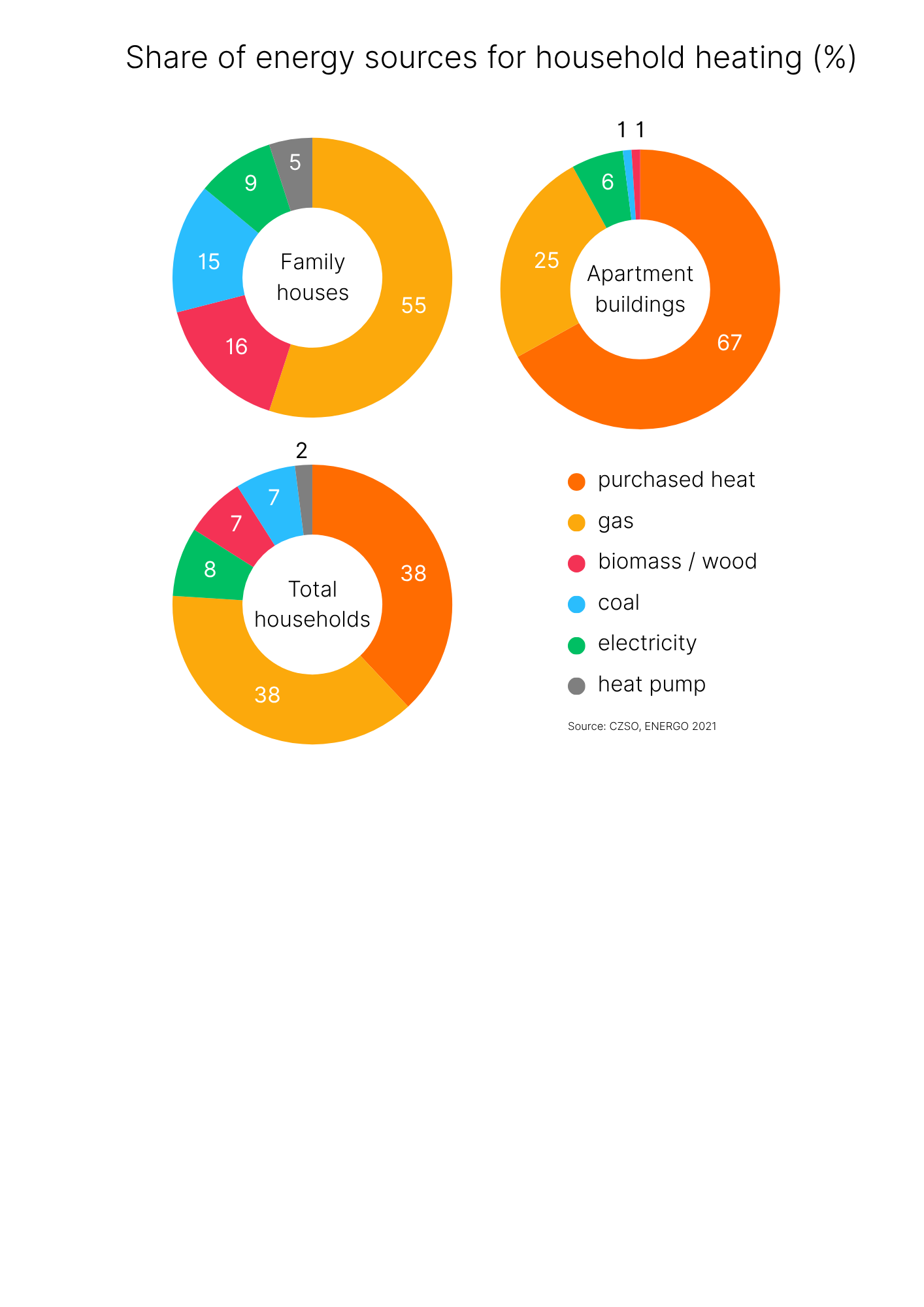
Over the past 15 years, the heating landscape in the Czech Republic has changed significantly. Coal has declined, natural gas has gained importance, and more recently, heat pumps have seen rapid growth. Renewable energy sources are receiving increasing attention, while district heating remains the dominant solution in apartment buildings.
Electricity still accounts for a smaller share of heating, but the growing number of residential solar PV systems is opening up new opportunities for energy savings and independence. Electric boilers, direct electric heaters and radiant panels are often seen as supplementary or emergency heating solutions. Yet modern infrapanels aim to deliver outstanding thermal comfort with less complexity and lower upfront investment.
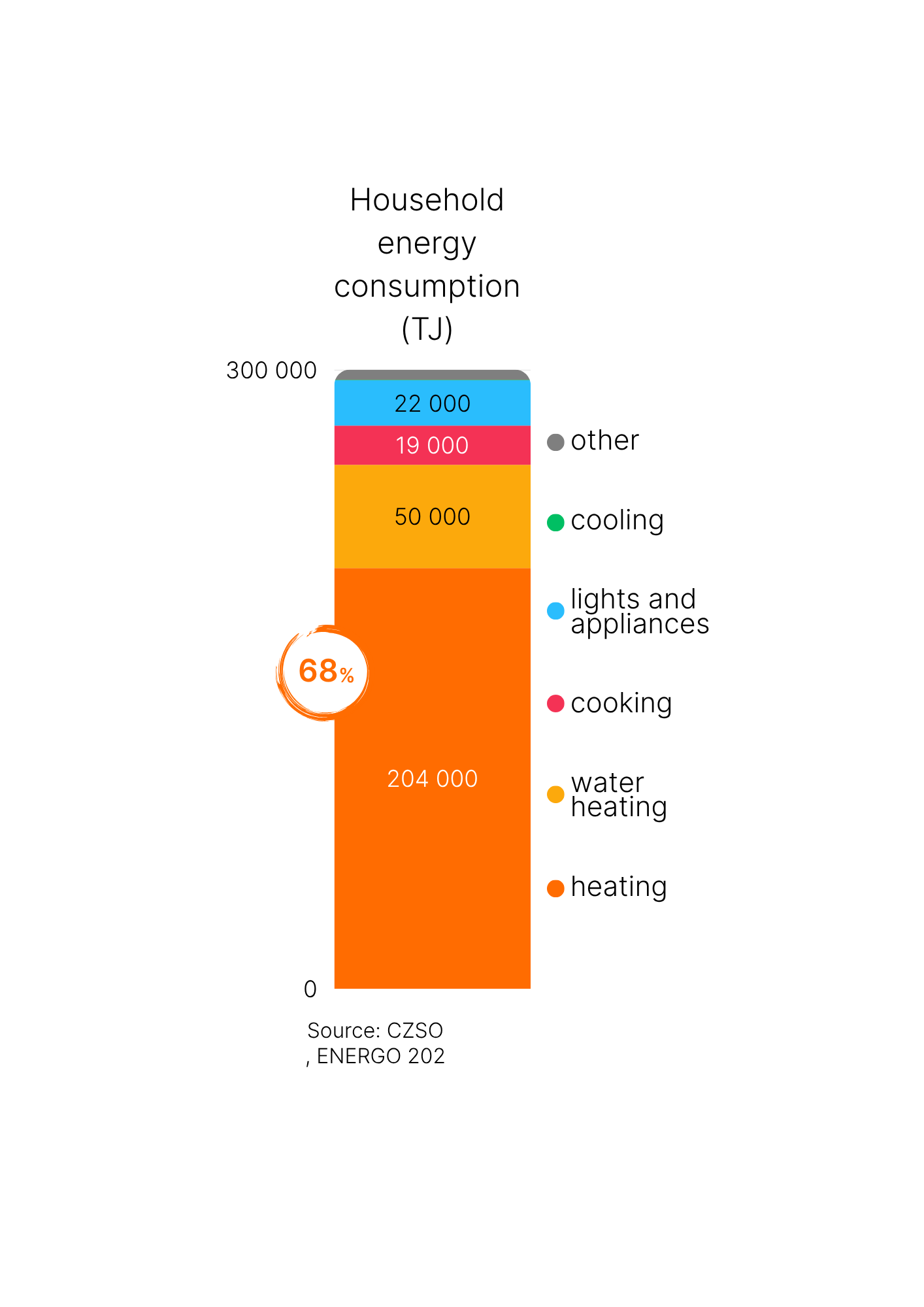
Heating accounts for the largest share of energy consumption in Czech households. In 2020, it represented approximately 70% of their total energy consumption.


Contact us via our free online configurator, email us at obchod@namiwell.com or call us on +420 797 662 922.
Go to ConfiguratorA well-designed heating system should not only maintain the right temperature but, above all, make a room feel comfortable. This depends not just on the air temperature but also on how warm the space actually feels. The impact of heating on indoor humidity and air circulation is equally important.
The ideal temperature in living spaces is 20 ± 1 °C. However, it’s not just about the temperature measured by the thermostat. An even distribution of warmth throughout the room and a stable temperature throughout the day are equally important.
Radiant heat transfer ensures thermal comfort even at lower air temperatures. Gently warmed surfaces and objects in the room enhance the overall sensation of warmth.
Electric heating systems respond immediately to changes in conditions or user preferences. They start heating as soon as needed, without lengthy warm-up times or unnecessary energy losses.
The absence of forced air circulation means less airborne dust, allergens and bacteria, which is particularly beneficial for people with allergies or asthma.
In heating systems that primarily warm the air, water vapour can condense on cooler walls. Radiant heating warms surfaces first, which in turn warm the surrounding air, helping to prevent condensation without excessively drying out the air.
Evenly warmed walls and the absence of cold spots help prevent water vapour from condensing, reducing the risk of mould growth.
In many indoor and outdoor settings, noise from heating systems is an important consideration. A heating system can operate in complete silence, without fans, pumps or compressors.
Infrapanels excel in every aspect of comfortable and healthy heating. They maintain a stable perceived temperature, gently warm walls and floors, do not dry out the air or create draughts, minimise dust circulation and operate in complete silence.
Thanks to the principle of radiant heating, they create thermal comfort in a natural way, similar to the warmth of the sun. This makes them an ideal solution, particularly in spaces where indoor air quality, occupants’ health and overall well-being are a priority.


Energy savings should never come at the expense of comfort. In some situations, it makes sense to maintain a consistent temperature once the space has warmed up and stored sufficient heat. In others, precisely controlled zoned heating is more suitable.
A good heating system should offer both options, adapting flexibly to how you use the space and to your individual needs.
Homeowners with smart solar PV systems can also benefit from significantly lower electric heating costs, for example by using a virtual battery.
Modern heating is no longer just about choosing a heat source. Advanced technologies play an important role in improving efficiency, enhancing comfort and reducing energy consumption.
For example, NAMIWELL infrapanels use DALYN® technology, which optimises heating dynamics and improves heating performance while reducing overall energy consumption.
The more complex the heating system, the greater the likelihood of breakdowns, the need for inspections and component replacements, all of which can lead to additional, often unexpected expenses.
Comfort is not the only consideration. It’s equally important to understand how much a heating system will cost, not just in terms of the initial investment, but also in running and maintenance costs over a period of 15 years or more.
Modern electric heating systems, such as infrapanels and electric boilers, convert electricity into heat with nearly 100% efficiency, with virtually no energy losses. Gas boilers achieve efficiencies of around 90–95%, while older models and solid fuel boilers typically range from 60 to 90%.
Heat pumps offer theoretically higher efficiency, as reflected in their coefficient of performance (COP), typically ranging from 3 to 5. However, their actual performance depends on outdoor conditions, the quality of heating controls and operating temperatures. In passive and low-energy homes, the practical advantage of this higher efficiency is often less pronounced.
It’s not just about how much heat we generate, but also where and how it is delivered. Heat losses occur in hot water pipework, mixing valves, circulation systems and radiators. Local heating systems, such as infrapanels, generate heat directly in the room without the need for distribution pipework, eliminating these losses.
When comparing initial investments, it’s important to consider not only the cost of the technology itself but also installation, system design, distribution pipework, technical room requirements, any necessary structural modifications and flue systems. Regular servicing costs and the lifespan of individual components, such as compressors and fans, should also be taken into account.
For comparison, we have prepared a sample calculation of total costs over 15 years of operation.
Infrapanels perform very well in terms of efficiency, energy losses, simplicity and long-term costs. By converting electricity directly into heat and eliminating the need for distribution pipework, they minimise energy losses.
They require neither complex technical infrastructure nor regular servicing, making them one of the most affordable complete heating solutions in terms of upfront investment.
When combined with solar PV systems, they can offer minimal long-term running costs without compromising comfort. Advanced technologies such as DALYN® take their efficiency even further.
Overall, infrapanels represent one of the simplest and most cost-effective heating solutions for modern homes.
The key considerations in this area are ease of installation and operation, zoned heating capabilities, integration with smart systems and the ability to utilise renewable energy sources.
Heating systems that require minimal structural modifications, distribution pipework or technical infrastructure are particularly advantageous for renovations and smaller buildings.
The simpler the heating system, the fewer operational worries, breakdowns and servicing requirements.
Independent temperature control in individual rooms is key to energy savings and greater thermal comfort.
Modern heating systems should be easy to control via mobile apps and seamlessly integrate with smart home systems.
Combining heating with decentralised energy generation, typically through solar PV systems, increases energy self-sufficiency and reduces running costs.


Robust technology with no mechanical wear offers reliable operation even after decades of use.
Key advantages include emission-free operation at the point of use, no combustion, no refrigerants and no complex disposal of components or chemicals.
Infrapanels are among the simplest heating systems to install and operate. They require no distribution pipework, pumps or technical rooms, which is particularly beneficial for owners of smaller homes and those undertaking renovations.
They offer precise zoned heating control, integrate easily with smart home systems and have minimal maintenance requirements thanks to the absence of moving mechanical parts.
With a service life of over 30 years, infrapanels operate silently, produce no on-site emissions, use no refrigerants and are completely maintenance-free.
If you’re looking for a reliable, simple and environmentally friendly heating solution, infrapanels excel in this category.


A well-designed heating system should allow additional zones or rooms to be easily incorporated without the need for extensive modifications.
An ideal heating system should be equally suitable for new builds, renovation projects, older homes, holiday cottages and offices.
Aesthetics, safety and system flexibility are often overlooked when choosing a heating system, yet they play an important role in practice, particularly in interiors with high aesthetic demands or in specialised types of buildings.
The appearance of a heating system should complement the character of the interior, either blending seamlessly into the surroundings or becoming a design feature in its own right.
A heating system should be safe to touch, pose no risk of injury, burns or fire, and emit no harmful substances.
Heating systems that use neither combustion nor refrigerants produce no local emissions (such as NOx or CO) that negatively affect indoor and outdoor air quality.
Infrapanels are among the most discreet heating systems available. Thanks to their slim profile and clean design, they can blend seamlessly into walls or ceilings, or become an attractive design feature in their own right.
They operate silently, produce no on-site emissions and are designed for safe operation, without releasing harmful substances or posing a risk of burns when properly installed.
Another advantage is their modular design: you heat exactly where you need to, and the system can be expanded at any time without structural modifications.
These features make infrapanels suitable for a wide range of buildings, from modern homes to holiday cottages, offices and nurseries.
To give you a clearer idea of the costs, we have prepared a calculation for a typical family home, a three-bedroom bungalow with an open-plan living area and a total living space of 150 m². The house is well insulated (24 cm Porotherm blocks with 20 cm EPS insulation, 16–30 cm cellulose ceiling insulation and triple-glazed windows), with a heat loss of 4.9 kW and an annual heating demand of approximately 8,900 kWh.
We compare commonly used heating technologies, from gas boilers and heat pumps to infrapanels, taking into account the initial investment, installation costs, maintenance and actual energy consumption over 15 years of operation.
See the comparison in an easy-to-read table.
What really stands out is the simplicity and efficiency of radiant heating. Compared with other heating technologies, NAMIWELL infrapanels are not only among the most affordable solutions to install but also the most cost-effective choice in the long term, thanks to their low energy consumption and maintenance-free operation. And by adding a solar PV system, you can achieve a high degree of energy self-sufficiency.
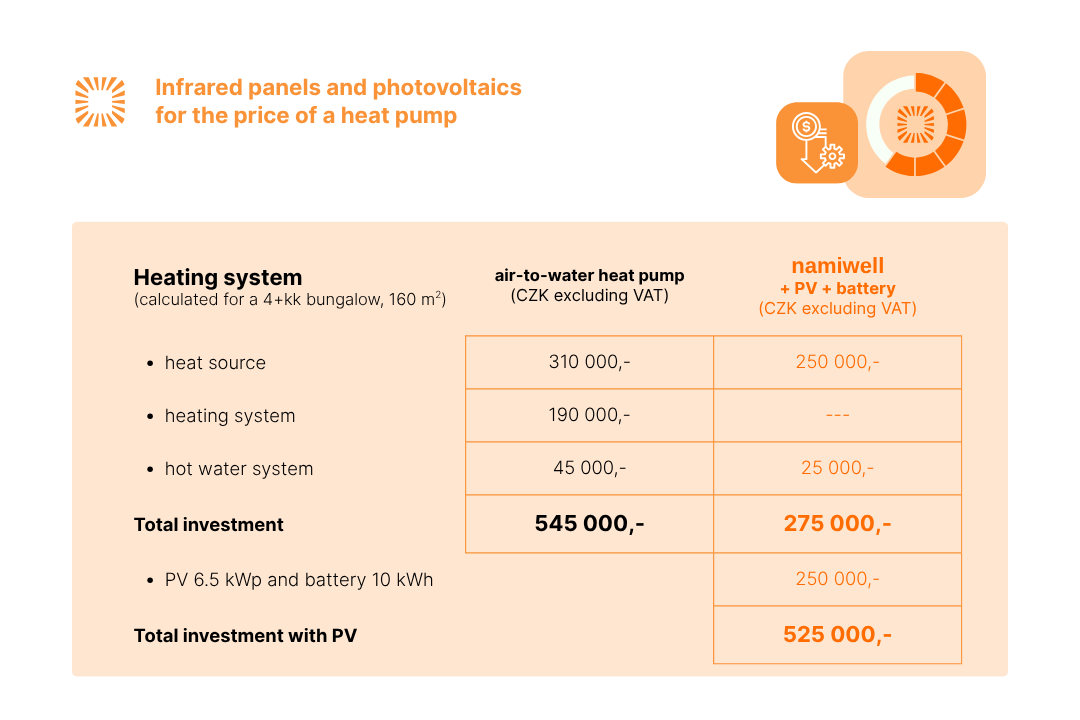
For our model home, we compared actual investment costs:
For the same or even lower investment, you get:
We’ve established the criteria. Now it’s time to apply them. Every heating system has its own advantages, and our comparison highlights the following:
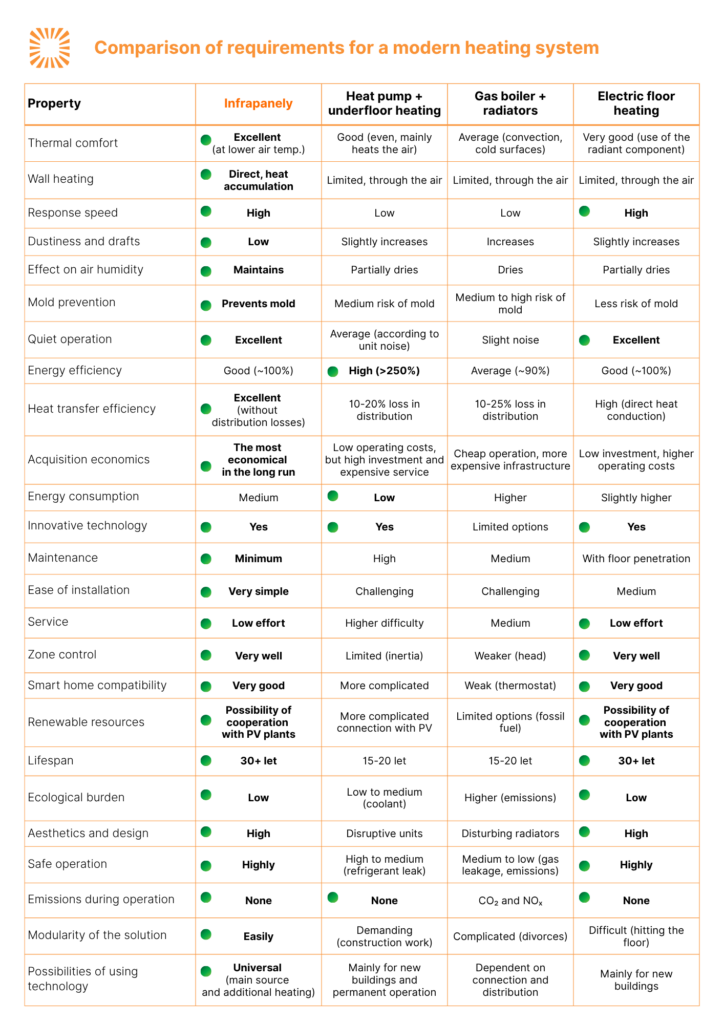
If you’re looking for a modern, flexible and clean heating solution that keeps costs to a minimum and offers worry-free comfort, infrapanels, particularly when combined with solar PV and smart heating controls, are a choice that makes sense both today and for the future.
Email us at obchod@namiwell.com, call us on +420 797 662 922, or simply try our configurator. We'll make sure you can enjoy comfortable warmth as soon as possible, at a reasonable cost.


